Invention of the printing press
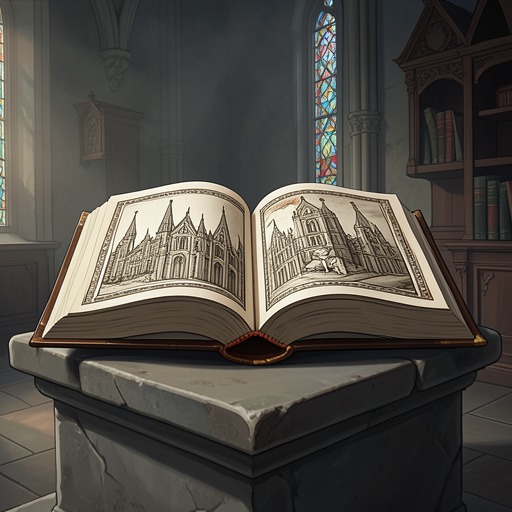
The Hunchback of Notre DameThe Invention of the printing press is presented as a decisive change in how societies preserve and circulate thought: the book begins to displace architecture as humanity’s principal public record. The shift is not merely from stone to paper. It changes the scale and mobility of ideas, loosens the arts from architecture’s authority, and helps turn religious dissent into a wider upheaval. The account sets this transformation against the built city, where generations had inscribed collective life in walls, streets, churches, and towers.
Before the Press: Thought in Stone
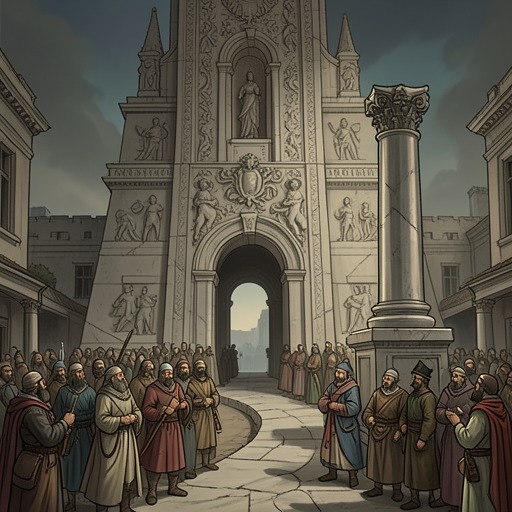
Before the fifteenth-century change, architecture serves as the chief register of humanity. Ideas that demanded durability took monumental form: religious laws and popular beliefs were worked into buildings, which preserved them in a material record more resistant than manuscript. A structure could embody the labor and resources of a whole society. Its making required not only thought but other arts, great quantities of stone and timber, and the coordinated work of many people. In this account, architecture is therefore not simply a craft or a collection of individual monuments; it is a shared medium through which a generation makes its ideas visible to those that follow.
The description of medieval Paris gives that claim a physical scale. The city begins on the island of the City, with the Seine as its first moat, and expands across the water as new walls and towers are overtaken by the growth of houses. By the fifteenth century, the City, the Town, and the University form distinct parts of one urban body. Two long streets cross all three, while the river and its bridges connect and circulate people among them. From the towers of Notre-Dame Cathedral, the view gathers roofs, chimneys, streets, bridges, spires, and bell towers into a dense panorama. The city’s complexity appears accumulated rather than designed all at once: small houses and major monuments alike bear traces of human making.
That monumental record is durable, but it is also tied to place and to the burdens of construction. A building concentrates an idea in a particular site, and the labor required to realize it is substantial. The press changes the terms of that comparison. Thought that once needed a mountain of stone, a forest of timber, a large apparatus, and the work of a nation can now take book form with paper, ink, and a pen. The contrast makes the printing press consequential not only because it reproduces words, but because it offers a more practicable means for ideas to travel.
A New Medium for Human Thought
In the account’s central reversal, the invention of printing is called the greatest event in history and the mother of revolution. Gutenberg’s letters of lead supersede the letters of stone associated with architecture. The change is figured as a transformation of thought itself: it sheds one form and assumes another. Where architectural expression gathers force in a particular place and period, printed thought can spread beyond the limits of a single building or city. The text compares this new circulation to a flock of birds scattering in every direction: what had been monumental becomes mobile and widely dispersed.
Print’s advantage, as the argument presents it, lies in this combination of reach and persistence. A mass can be demolished, whereas a dispersed medium is difficult to extinguish everywhere at once. A flood might submerge monuments, but printed thought can survive by moving beyond any one place. The book is therefore not simply a smaller substitute for a building. It changes the conditions under which ideas endure and reach others: less dependent on a fixed structure, less encumbered by the resources needed to construct one, and able to occupy many places at once.
The transition is gradual rather than instantaneous. In the fifteenth century, the press is still described as too weak to drain architecture of its vitality; for a time it draws on the life of an already powerful art. But the balance shifts. As printed expression gains strength, architecture loses its former role as society’s total medium. The narrative treats this change as an ebbing of collective thought from building: the withdrawal is nearly imperceptible at first, then increasingly visible from the sixteenth century onward.
Architecture After Its Displacement
The narrative identifies the Renaissance with architecture’s decline from its former social authority. This is a deliberately critical account of the period: architecture turns from a living, indigenous expression into an imitation of classical forms, and the Gothic tradition is described as a setting sun whose remaining light briefly falls across a hybrid style. The judgment concerns more than appearance. Once architecture no longer gathers the other arts under its command, they become independent practices: sculpture separates into statuary, image-making into painting, and the canon into music. What had belonged to a single artistic order breaks into distinct fields, each able to develop on its own.
The account traces the architectural consequences through later centuries. It describes buildings becoming increasingly governed by geometric forms, with artistic lines yielding to colder, more rigid structures. Styles and examples change, but the larger diagnosis remains: architecture becomes less able to express the thought of its time. Its later imitation of celebrated forms is presented as evidence of a medium living on after the social force that once animated it has ebbed. Printing, by contrast, takes up the energy that buildings lose. The change is not framed as an immediate disappearance of architecture, but as a long decline in its status as the foremost language of collective ideas.
This contrast also recasts the cityscape. The crowded Paris seen from Notre-Dame Cathedral’s towers remains a record of accumulated human labor, but it no longer stands alone as the leading form through which humanity can make its thought endure. Stone continues to embody the past; the press allows thought to circulate beyond the local and monumental frame. The change in medium therefore alters how the city’s buildings can be understood: still significant as a historical record, but no longer the uncontested record of the present.
Religious and Historical Consequences
The invention of printing has particular force in the account of religious change. Medieval dissent had already weakened the unity of Catholicism, but without the press, reform would have remained a schism. Printing, the narrative argues, converts it into a revolution by giving ideas a means to spread beyond the limits of their original setting. Gutenberg is consequently presented as a precursor to Luther: the point is not that the press alone supplies religious arguments, but that it changes the reach and effectiveness of their circulation.
The subsequent chronology extends that claim beyond the sixteenth century. In the seventeenth century, print is established strongly enough to preside over a great literary age. In the eighteenth, it takes up the challenge once associated with Luther and puts it in Voltaire’s hands, directing its force against an old European order whose architectural expression, the narrative maintains, has already been undermined. By the close of that century, print has destroyed the old arrangement; in the nineteenth, it begins to reconstruct. The sequence makes the press an active historical force, not a passive instrument that merely records changes begun elsewhere.
The event’s significance thus lies in a transfer of expressive power with consequences across culture and politics. Architecture had made thought durable by giving it monumental form; printing makes it durable through reproduction and circulation. The former gathers meaning into buildings and places, while the latter disperses it across a wider field. In this interpretation, the printing press changes not only how ideas are preserved, but how far they can travel, how readily they can challenge religious unity, and which art can claim to express the movement of an age.